


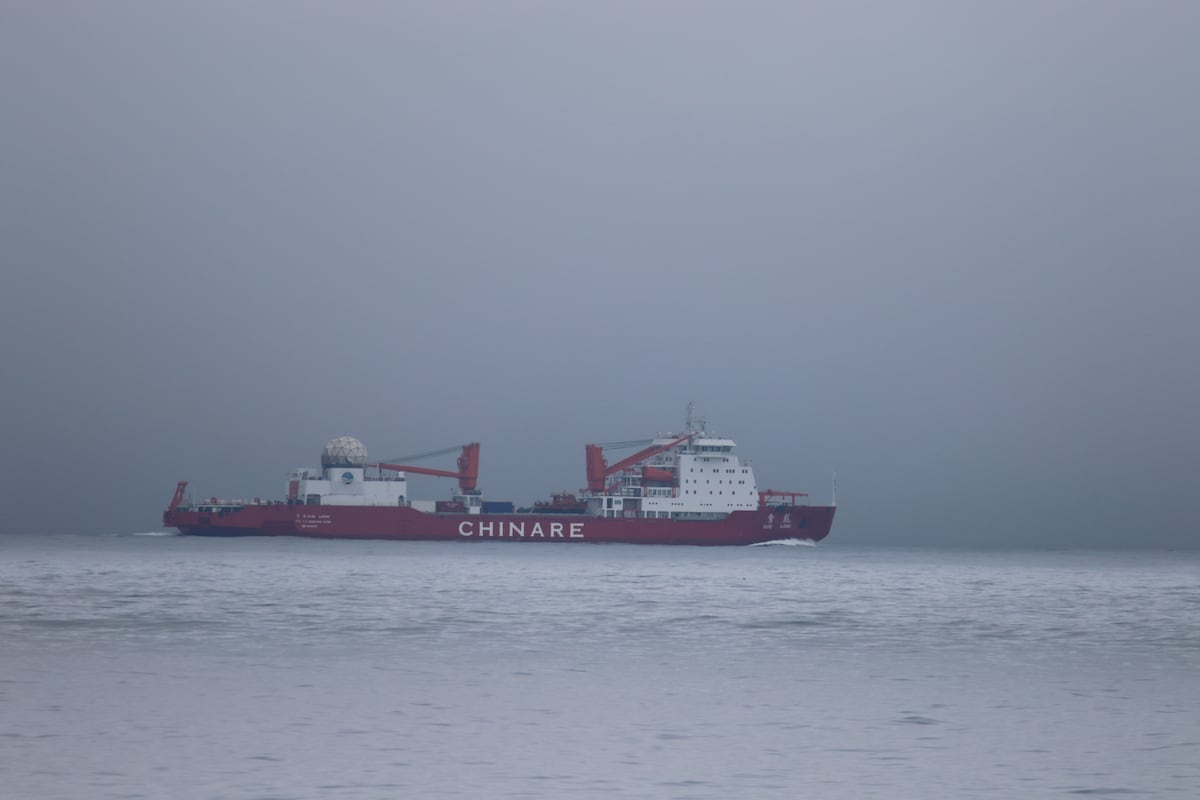
The U.S. Coast Guard began tracking a Chinese research vessel last week near the Arctic to ensure compliance with international law, the service announced.
The U.S. Coast Guard Cutter Munro observed the Chinese ship Xue Long as it transited through the U.S. exclusive economic zone and over the U.S. extended continental shelf in the Bering Sea toward the Arctic.

“Alongside the Department of War, the Department of State, and our international partners, we are actively responding to competitor activities across an increasingly contested Arctic,” said Rear Adm. Bob Little, commander U.S. Coast Guard Arctic District.
The U.S. Coast Guard completed the surveillance in service of Operation Frontier Sentinel, which tracks U.S. adversaries in and around U.S. waters in order to protect U.S. national security interests.
It was the first time in 2026 that Chinese vessels were recorded transiting the area, the Coast Guard said.
The thawing of ice sparked by climate change has opened up opportunities to traverse previously inaccessible shipping lanes and extract rare earth minerals.
Nations that seek to conduct marine scientific research inside the U.S. EEZ and or in the U.S. extended continental shelf must request permission from the United States before doing so.
In Sept. 2025, the U.S. Coast Guard responded to two Chinese research vessels that were operating in the Arctic.
As geopolitical tensions rise in the region, the U.S. is increasingly focused on instilling security in the Arctic, investing hefty capital and developing new military courses and initiatives to accomplish this goal.
President Donald Trump signed an executive order on Oct. 8, 2025, instructing the Department of Homeland Security to expand its fleet of Arctic Security Cutters to address the “growing threat” in the region.
In February, the U.S. Coast Guard awarded a contract to defense manufacturer Davie Defense, Inc., to build five cutters, bringing the total amount of cutters currently under contract to 11.
The contract, worth $3.5 billion, is scheduled to deliver the first cutter in 2028.
The Air Force and U.S. Marine Corps are also following suit.
The Alaskan-based 673d Security Forces Squadron rolled out a new five-day combat course that prepares airmen for long-term combat in the rigid environment.
And the U.S. Marine Corps introduced a new Alaska rotation to train service members for military operations in the extreme cold.
Riley Ceder is a reporter at Military Times, where he covers breaking news, criminal justice, investigations, and cyber. He previously worked as an investigative practicum student at The Washington Post, where he contributed to the Abused by the Badge investigation.
Read the full article here