

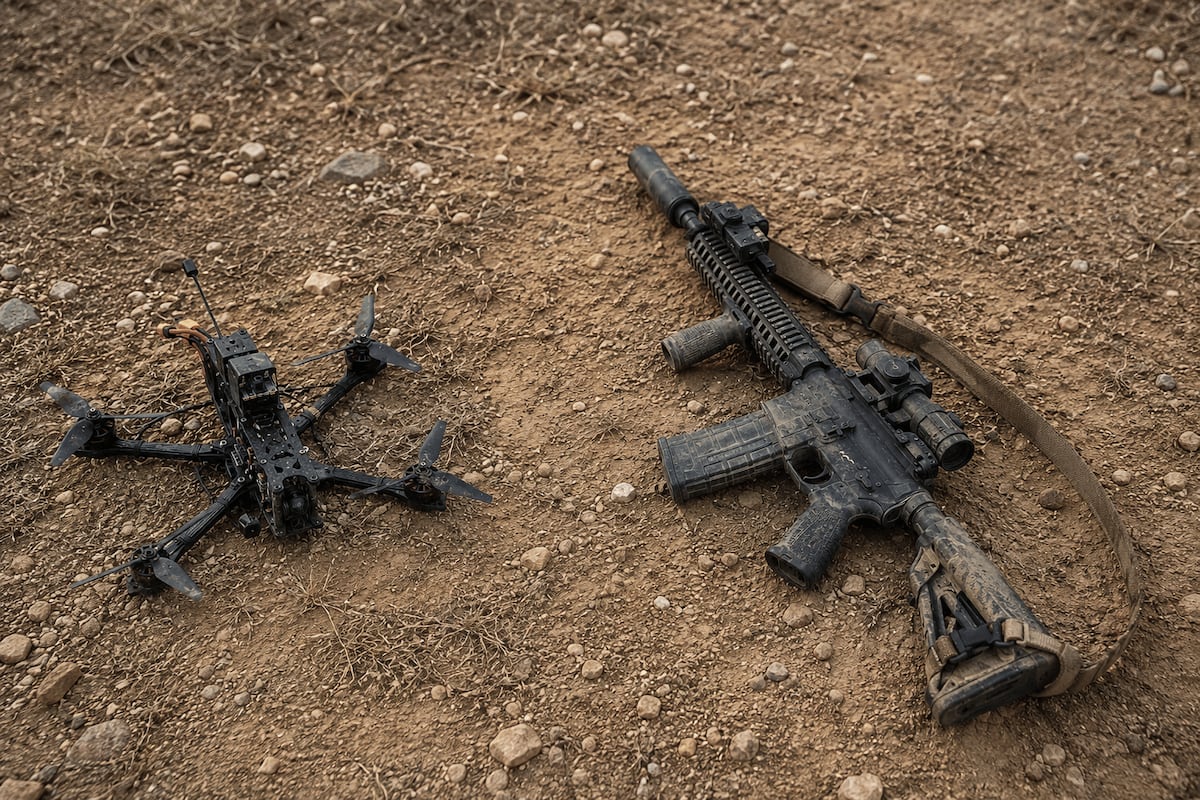
Logic suggests that a shotgun would be the best firearm to use to take out an enemy drone as it has long been the weapon of choice to shoot down small aerial targets. That’s because inside a shotshell contains pellets that spread as they fly down range, which increases the odds of hitting a flying target.
When compared to a rifle, though, a shotgun is less capable on the battlefield because it holds less ammunition, has a significantly shorter range and delivers more noticeable recoil. It also poses logistical hurdles. Someone has to carry it along with ammo that’s incompatible with other squad weapons.

In a nutshell, that’s how anti-drone ammo was born. Connor Schnepf, co-founder of the Arizona-based company Drone Round, explained that about a year ago, he and his partner were already making targets in the defense space when they learned that shotguns weren’t really working to address the military’s drone problem.
“It kind of sparked the idea with one of our other business partners. He was like, ‘Hey, we make ammo. Let’s make a rifle cartridge that almost simulates a shotgun that you can use in a regular battle rifle to shoot down drones,’” he said in an interview with Fox 10 Phoenix.
A small unmanned aerial system, or UAS, equipped with an explosive device can be used to destroy major infrastructure and expensive equipment. In turn, traditional counter measures prove either to be ineffective or too expensive to deploy. Therefore, the U.S. military is prioritizing inexpensive yet practical solutions.
Although Drone Round isn’t the only company making anti-drone ammo, the Marine Corps said in a notice of intent filed in June that its 5.56 L Variant is the only kinetic munition currently available in the commercial and defense marketplace that meets the service’s minimum standards for immediate counter-drone defense.
“Specifically, this round is the only solution offering ‘drop-in’ compatibility that requires no physical modifications, specialized upper receivers, or distinct weapon platforms to be operable in current-issue Marine Corps 5.56mm weapons,” the announcement said, referring to the M27 and M4A1.
Last week, the service confirmed with Task & Purpose that it has already bought 400,000 rounds from the company and plans to buy another 1 million in the next fiscal year.
Justin Lawrence, the company’s other co-founder, explained that the L Variant functions like a standard 5.56mm cartridge, but it has multiple projectiles.
“It’s essentially five bullets coming out of one trigger pull. Basically, what the real technology and advantage is sticking with the one caliber in a rifle platform, your soldier [or] warfighter is already carrying,” he said. “So you don’t have to change to a 12 gauge because these FPV drones move very fast and it’s something you need to have very quickly.”
From a logistical standpoint, a single magazine loaded with anti-drone ammo replaces an entire weapon system or expensive countermeasure.
Schnepf added that although they came up with the idea about almost a year ago, they didn’t have the ability to scale production, so they partnered with the Idaho-based Freedom Munitions. He said together, they now produce millions of rounds per month.
“The capability truly fills a gap in what we call counter UAS or counter unmanned aerial systems, so it is a needed solution … It’s like, you know, we brought water to a desert and they can’t keep enough of it because it’s so needed.”
Daniel Terrill is a contributor to Military Times. He’s been reporting on military issues, the gun industry, and the outdoors for nearly two decades. Although writing is his passion, he’s been a Marine, police officer, and, perhaps the most dangerous job of his career, a substitute teacher.
Read the full article here