
Colby Barrett went to scout sniper school because that’s where his Marines were headed. Years later, that training took him to a front-line unit in northern Ukraine to shoot alongside one of the war’s most accomplished marksmen.
Barrett was commissioned through Navy ROTC in 2000 and spent four years leading infantry and scout sniper Marines from 2000 to 2004.
When most of his platoon headed to sniper school, he went with them.
It was a “pretty unusual” move for a Marine officer, he told Military Times.
The Marine Corps has since trained its final scout snipers and moved sniper training into reconnaissance and Raider units under Force Design 2030.
After the Marines, Barrett built a business, sold it and started farming. When a friend asked him to join an aid convoy to Ukraine, he had four kids in school and a harvest underway. His first answer was no.
That night, he read about pastors killed and churches destroyed by Russian forces. As a Christian, he wondered how he’d missed it. He made the trip, then kept going back.
Now, despite declaring that he is “not a filmmaker,” Barrett has produced two series on the war in Ukraine: A Faith Under Siege and Faith in War. Within that series is Safe Ground, the story of a Green Beret who removes landmines in Ukraine.
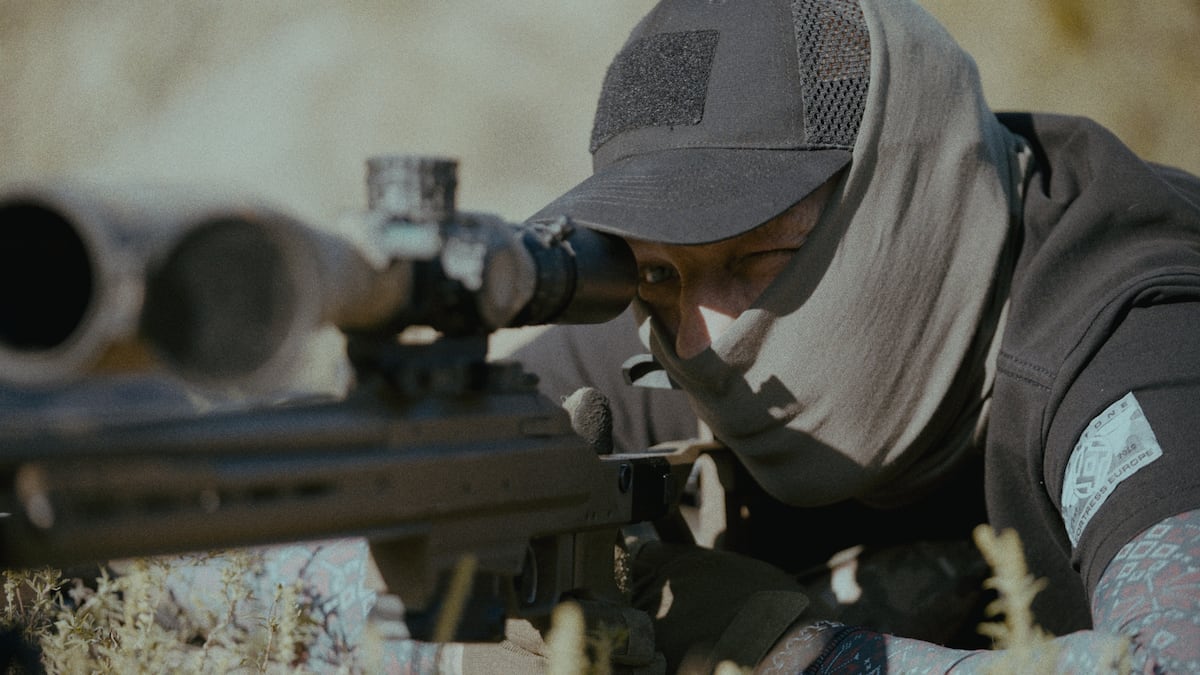
During those trips, Barrett heard about a sniper with the call sign of Lektor, a special forces sniper from the Department of Active Measures with Ukraine’s Defence Intelligence, who, in December 2024, hit a moving Russian soldier at 2,069 meters using a single .338 Lapua Magnum round from a Sako TRG M10. He fired standing in a trench, nearly level with his target, and hit on the first shot.
Lektor is still running missions and only reluctantly agreed to press, Barrett said. Soon, however, Barrett’s time with Lektor will become a short documentary.
Barrett’s crew spent a morning on the range with his unit testing whether American M118 ammunition could match its costly hand-loaded rounds. Lektor said there was “practically no difference,” so the unit stuck with the M118 it already had.
“I was struck by just his humility,” Barrett said.
Lektor, a former gamekeeper, waved off the praise.
“Honestly, I don’t consider myself a super expert,” he told Barrett’s crew in an interview translated from Ukrainian. “This is my job for the duration of the war.”
Before the shot, his team had spent two weeks on the zero line watching for a Russian assault, under orders not to fire. When the situation changed and the team was set to move, Lektor asked for one more chance.
“So I simply begged the commander: give us a day or two for free hunting,” he said.
He spotted a soldier whose gear set him apart from ordinary infantry. The man was walking a tree line at a steady pace and a workable angle. As Lektor prepared to fire, his partner called a wind correction in the wrong direction.
“I managed to shout: recalculate, something’s wrong,” Lektor said. They fixed it in seconds while the target was still moving.
Barrett pointed to the longest confirmed .338 Lapua kill — British Cpl. Craig Harrison’s 2,475-meter shot in Afghanistan in 2009 — which came after several sighting rounds. Shots like that, he said, are “really more like competition shooting.” Lektor is skeptical of the rankings for the same reason.
“Two shots maximum: if you didn’t hit, that’s it,” he said. “That’s how you should compare.”
Within half an hour of the shot, drones were overhead.
“The only thing that saved us was that the enemy didn’t expect a shot from such a distance,” Lektor said. The Russians shelled an area about 500 meters out. His team waited a full day in a dugout before slipping out.
Now, thermal cameras hunt for heat.
“After a shot, a simple suppressor can give you away, because it’s hot, it glows,” Lektor said.
Early in the war, Lektor said, the walk to a firing position was about a kilometer. He now walks eight.
Barrett asked him whether snipers were even relevant anymore. Lektor admitted the role is “a little outdated” but not finished.
“Snipers, in my opinion, are the neurosurgeons,” he said. A sniper team can watch a sector almost continuously, he explained. “Drones have to return to recharge, they get shot down.”
Near Bakhmut, Lektor’s team killed a Russian sniper. A neighboring unit then told them he was the fifth one killed at that position.
“They have absolutely no regard for the lives of their own men,” Lektor said.
Barrett sees Ukraine’s regard for its own people as an advantage, along with its speed in adapting to new technology. Russia, he said, treats the war like a meat grinder: “If I just put so much meat into it, that it breaks the grinder, then we’ll win.”
Lektor’s son enlisted first, and the two have served together most of the war.
“He’s my child, I have to be there,” Lektor said.
Once, while Lektor was hospitalized with wounds, his son was fighting with another team in Chasiv Yar. He was the only one of four men in his group to come out unharmed.
On his own team, Lektor keeps one rule.
“I [am] the first to go in and the last to come out,” he said. “That’s our unwritten rule.”
Read the full article here