



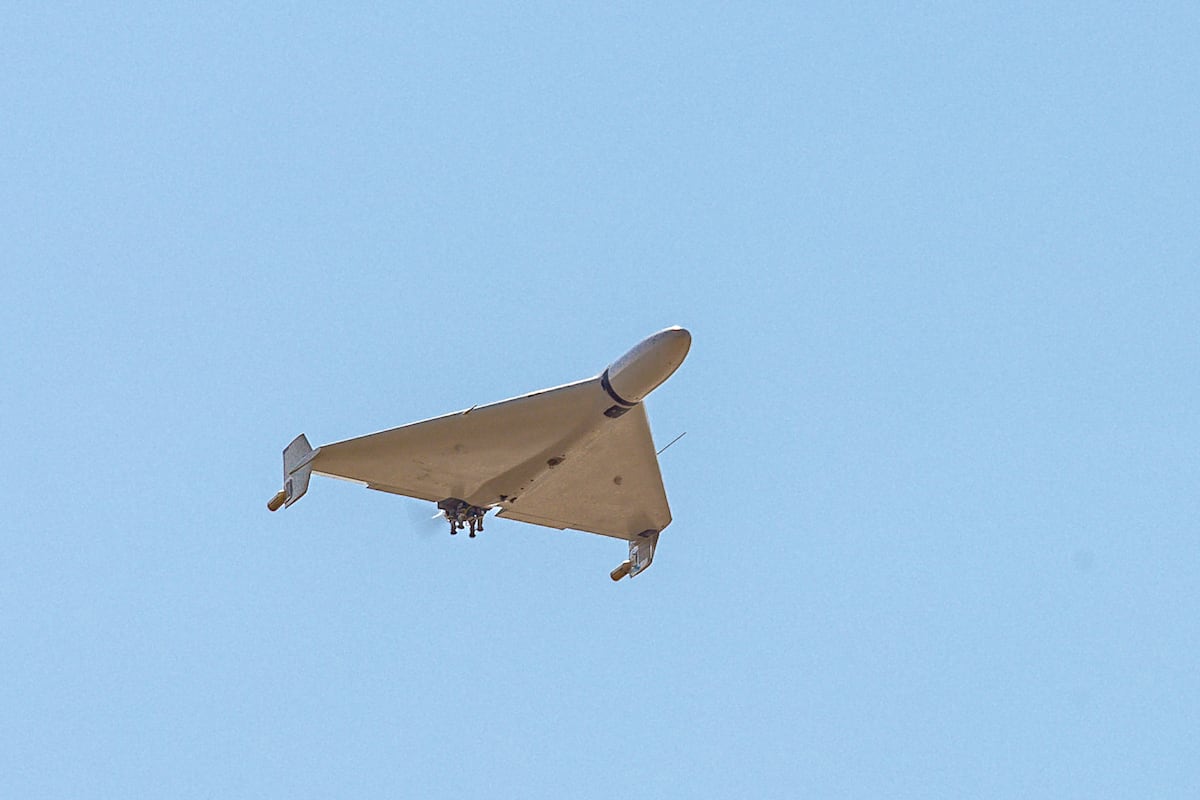
The U.S. Army is looking for companies that can provide a 50mm cannon and ammunition for counter-drone defense.
The goal is to “integrate a 50mm ammunition solution to effectively track, engage, and defeat Class 1, 2, and 3 UAS threats,” according to the Army’s Sources Sought notice. The deadline is Aug. 31.
While the notice from the Army’s Project Manager, Maneuver Ammunition Systems office does not provide any technical specifications, it signals the Army’s interest in a rapid-fire cannon for counter-UAS, or C-UAS, defense.

In particular, the Army will conduct a live-fire demonstration using Northrop Grumman’s XM913 Bushmaster 50mm chain gun, with companies supplying 50mm ammunition for testing.
Contractors are asked to provide “a detailed description of the company’s capabilities pertaining to C-UAS, proposed C-UAS system architecture, fire control/sensor integration, detailed draft test or demonstration plan, and how the platform will successfully employ the 50x228mm ammunition against the specified target set. In addition, the response shall provide a detailed, estimated timeline and schedule to design, integrate, and deliver a weapon system ready for a live-fire demonstration.”
The cannon is intended to destroy a broad range of drones, from Group 1 to Group 3. This includes tiny quadcopters all the way to medium-sized UAVs weighing up to 1,320 pounds and traveling at 250 knots.
Such drones have emerged as perhaps the biggest threat to armored vehicles, which have been largely driven off the front lines of the Ukraine war because of masses of UAVs.
RELATED
The XM913 is slated to be the primary weapon on the XM30 Mechanized Infantry Combat Vehicle, which is intended to replace the M2 Bradley. In 2023, the Army awarded contracts to American Rheinmetall and General Dynamics Land Systems to develop prototypes for the XM30, formerly known as the Optionally Manned Fighting Vehicle.
The XM913 weighs 692 pounds and can fire single shots, bursts, or up to 200 rounds per minute. It will fire the XM1203 Armor Piercing Fin Stabilized Discarding Sabot with Trace, or APFSDS-T. More significant for targeting agile and fast drones, the XM913 will use the XM1204 High Explosive Airburst with Trace, or HEAB-T.
HEAB-T “will most likely be the standard ammunition, replacing the High Explosive (HE) ammunition in service today that relies solely on a point detonating fuze capability,” claimed a 2020 Army news release.
HEAB-T will use a programmable fuze with point detonate, point detonate delay and airburst modes.
“Today, a gunner uses high explosive rounds fired from the 25mm M242, and has to walk rounds into each target to achieve the desired effects,” the news release said. “With the HEAB-T, the gunner can depart from this type of engagement. By using airburst mode, the round will be programmed with range to the target — and other important factors — for maximum lethal effect with an order of magnitude fewer shots.”
While “flak” was once thought obsolete because of surface-to-air missiles, armies are turning to cannons and machine guns as cheaper alternatives to using $4 million missiles — or wearing out manned fighter jets — to destroy a $20,000 drone.
Ukraine has had some success in creating dense belts of short-range anti-aircraft cannons and mobile machine guns to stop Russian drones.
Michael Peck is a correspondent for Defense News and a columnist for the Center for European Policy Analysis. He holds an M.A. in political science from Rutgers University. Find him at theuncommondefense.com. His email is mikedefense1@gmail.com.
Read the full article here