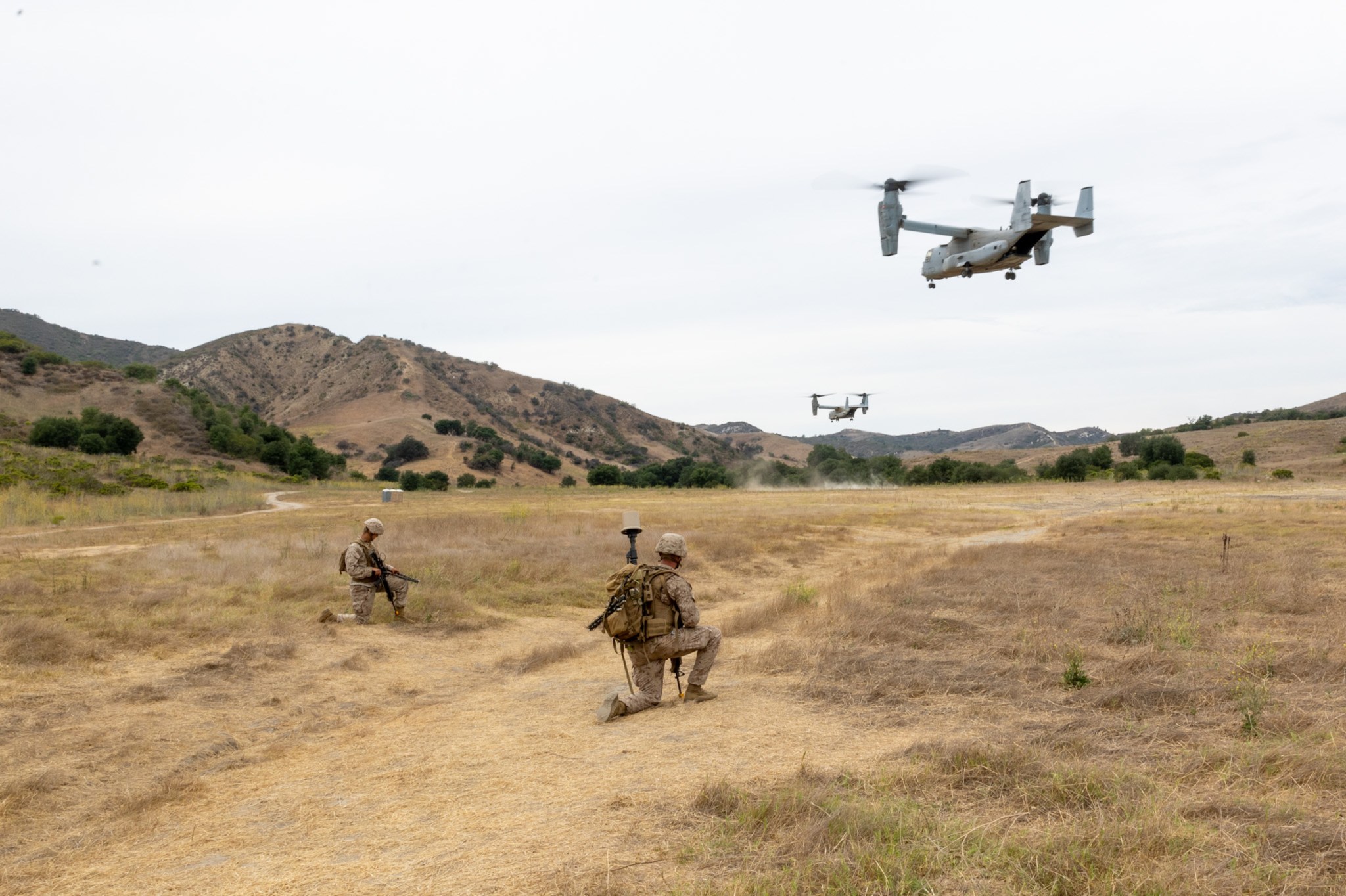
On the heels of scrutiny from lawmakers earlier this year about plummeting readiness rates for the Marine Corps’ multi-capable MV-22 Osprey, the Corps is moving to adopt an AI-based diagnostic and decision-making tool for all its East Coast-based squadrons.
That’s according to the maker of the tool, Virtualitics, which initially fielded its technology to Air Force B-52 squadrons and has since expanded across that service and to other military components. According to Virtualitics Chief Commercial Officer Rob Bocek, who spoke to Military Times in an interview, the tool, Iris, uses a group of AI agents that coordinate with frontier AI models to pinpoint where capability and readiness gaps exist and make specific recommendations on how to improve outcomes.

“If you were to ask the very same question in just a generic [large language model], you would not get the depth, the richness. It would be just kind of a generic response,” he said. “These … models can be configured and tuned so that when you ask a very specific and very complex question in our chat interface, you get a very specific response back. Those capabilities don’t exist in the [Defense] Department elsewhere.”
According to Bocek, Virtualitics tools have already been used to save the Air Force 50,000 man-hours in more efficient munitions storage, with AI calculations assessing not only available space but also safety considerations around net explosive weight and packing density. They have also informed decisions about which weapons to deploy, presumably in support of Operation Epic Fury earlier this year, Bocek said.
“There was a specific kinetic effector that needed to be fielded rapidly, and based on the quantities that were being sent over, our system basically said, that’s not enough; this is the appropriate number, and here’s why,” Bocek said.
“And I think it’s that blind spot where there was this ‘aha’ moment, where we’re now able to use AI for these types of very, very complex decisions, and then understand too what are the second- and third-order effects if we just deploy certain capabilities to certain parts of the world — what’s the downstream effect six months from now, a year from now. And so now leaders, decision-makers have that level of visibility, which I think is very powerful,” he added.
The Marine Corps’ 2nd Marine Aircraft Wing, covering all of its East Coast aviation squadrons, first contracted with Virtualitics for readiness tools in 2025. This contract renewal will provide Iris to all six stateside MV-22 squadrons within 2nd MAW, and be extended to a seventh when it returns from its current deployment, according to the company.
Ospreys across the Marine Corps have been in a limited operating status since 2023 due to a gearbox issue responsible for the fatal crash of an Air Force CV-22 Osprey that year. Officials most recently said the platform would return to full flight operations by the end of 2026.
In a February congressional hearing, one lawmaker bemoaned the number of “hangar queens” in the Osprey fleet – aircraft that never reach the flightline and depress readiness rates. That hearing revealed that Osprey readiness rates had slipped from a previously reported 60% to around 50% for the Marine Corps and 40% for the Navy, which has a much smaller fleet of the aircraft.
Bocek said improving mission capability rates was a clearly stated goal for the Marine Corps in adopting Iris for the Osprey. Iris, he said, will be able to identify supply gaps and ways to improve efficiency. Another component of the system, he said, is a scheduling optimizer.
“If we have a sortie in the next 48 hours, what assets do we schedule,” he said, “and more importantly, understanding what are the downstream effects on maintenance and support if we select these tail numbers. And so our AI is able to pull together a pretty comprehensive picture of that and pull together a pretty comprehensive picture of that and provide that decision trade space for the operators.”
With increased interest across the Pentagon in exploiting newfound AI capabilities, Virtualitics has been “on a tear,” Bocek said, quadrupling revenues over the last two years. Revenues may triple again this year, he said, with additional military contracts set to be announced over the next 90 days.
Read the full article here